Why Hospitals, Offices, Factories, and Retail Spaces Need Different Vastu Approaches

Enquire Now


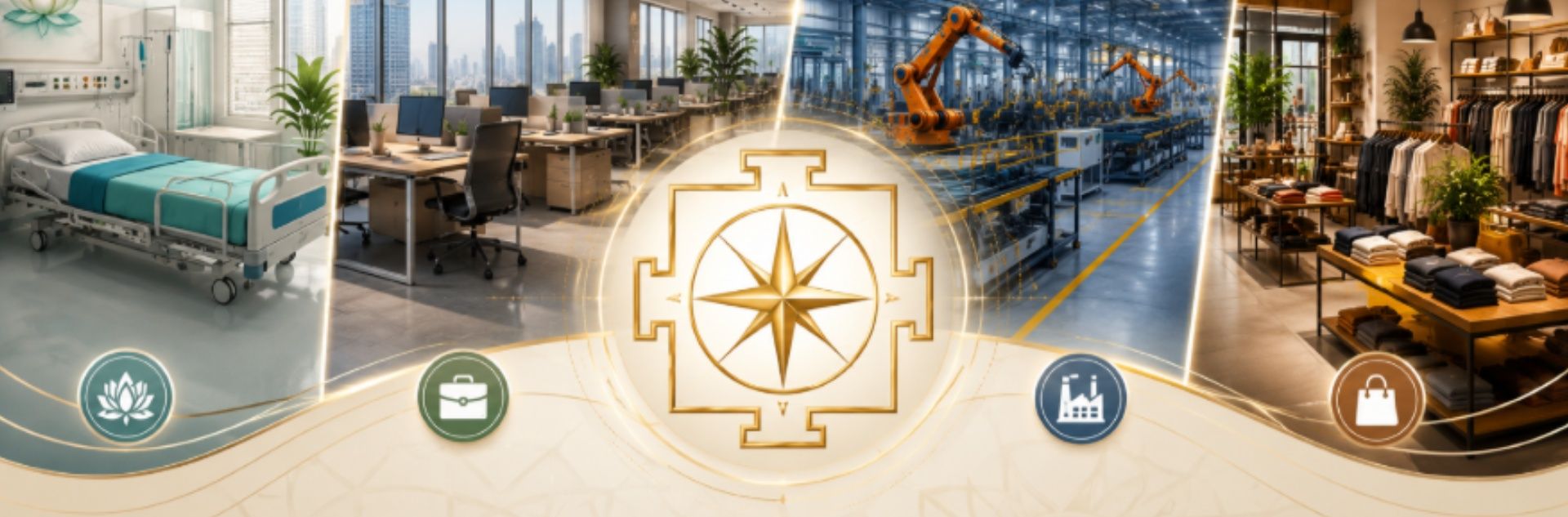
Vastu Shastra is a deeply layered spatial science. What makes it genuinely useful in real world projects is something that often gets overlooked. It does not work the same way in every kind of space. The principles stay consistent but how they are applied depends entirely on what a building is built to do and who it is built for.
Developers and architects working across different project types understand this distinction well. And for business owners who have experienced Vastu applied thoughtfully in their own environments, the difference it makes is hard to miss.
Every built environment serves a specific human purpose. A hospital is there to support healing. An office is there to sustain focus and clear thinking. A factory is there to keep materials moving through a production process without unnecessary friction. A retail space is there to welcome people and create the right conditions for a decision.
These are four very different purposes. So naturally, the spatial approach for each one needs to reflect what that space is actually trying to do.
In a vastu for hospital building, everything comes down to two things. How well patients recover and how smoothly the facility runs.
The northeast zone brings light, openness, and calm. ICU and critical care units do well here because patients in these spaces need that quality of environment more than anywhere else. Emergency and casualty departments belong in the southeast, where the fire element supports urgency and fast response. Operation theatres need the west or southwest, where the energy is stable and precise. Inpatient wards in the south or west feel more settled and restful, which suits patients staying for several days.
When the layout follows this logic, the hospital genuinely supports the healing process.
An office needs a different kind of spatial energy altogether. The north zone in Vastu is associated with clarity and prosperity, so it works well for senior leadership, boardrooms, and key decision making areas. Meeting and collaborative spaces find a natural home in the northwest, which governs movement and communication. Workstations facing east or north help people stay focused through the working day.
A well zoned office looks organised and people can experience positive energy. People working in it feel the difference, and over time that shows up in how the team performs.
In a vastu for commercial building used for industrial purposes, the focus is on keeping operations moving without friction. Heavy machinery belongs in the south and southwest because those zones carry the earth element and the stability that heavy equipment needs. Boilers, generators, and electrical systems go in the southeast, the fire zone. Logistics and dispatch work naturally in the northwest because air governs movement.
According to Vastu principles, the centre of the site, the Brahmasthan, needs to stay open. In many factories it becomes a storage area simply because it is convenient. But it is evident that a blocked centre creates circulation problems that grow quietly over months and start affecting output.
Retail is entirely about how people feel the moment they walk in. An entrance in the north or northeast creates an immediate sense of openness and welcome. Product display areas in the east and north support a positive energy around the merchandise. Cash counters in the southeast or south keep the financial energy of the space stable.
A retail environment that feels naturally good to be in is not a coincidence. It is the result of spatial decisions made with a clear understanding of how people respond to their surroundings.
Directional alignment, elemental balance, energy flow, and the relationship between a space and the people using it. These ideas run through every project type, but how they are expressed changes completely depending on what the space needs to do.
At Sayash Vastu, every project starts with that question. What does this space need to do? And how can every planning decision support that purpose from the very beginning?
"The best spatial planning is not visible. It is felt in how a space performs, how people experience it, and how it holds up over time."
Sayash Vastu has worked across hospitals, offices, factories, and retail developments in India and internationally for over three decades. To understand how a personalised Vastu approach can strengthen your next project, visit sayashvastu.com or connect with Team Sayash Vastu directly.
A hospital needs to support healing, an office needs to support focus, a factory needs smooth operational flow, and a retail space needs to feel welcoming. Simply put, What works for a space meant for healing is not what a production floor needs. The approach changes based on what the space is actually for.
2. What matters most when applying Vastu to a hospital building?
Mostly two things, patient recovery and operational efficiency matters the most. Placing ICU units in the northeast, emergency departments in the southeast, and operation theatres toward the west or southwest all play an important role in how well a hospital functions for both patients and staff.
3. Can Vastu actually make a difference in an office?
Definitely it can, and people tend to notice it without realising why. Leadership areas placed in the north, meeting rooms in the northwest, and desks facing east or north all contribute to a space that feels easier to focus in. A well planned office layout supports focus, clarity, better team performance, and decision making.
4. Why is thecentreof a factory considered so important in Vastu?
That central area, known as the Brahmasthan, must stay open for energy to circulate freely through the facility.. It often gets used for storage because it is the easiest spot available, but over time a blocked centre tends to create the kind of circulation issues that quietly affect how the whole facility runs.
5. How does Vastu shape the experience of a retail space?
A lot of it comes down to first impressions. Entrance placement, product display zones, and the position of cash counters all contribute to creating a welcoming, energetically balanced environment for customers.
6. Has Sayash Vastu worked ondifferent typesof projects like these?
Yes, for over three decades now, across hospitals, offices, factories, and retail spaces, both in India and internationally. The approach is never the same template applied everywhere. It is shaped around what each project actually needs.
Read more: Effective Vastu Tips for Improving Factory Layout