How Developers Can Integrate Vastu at the Master Planning Stage

Enquire Now


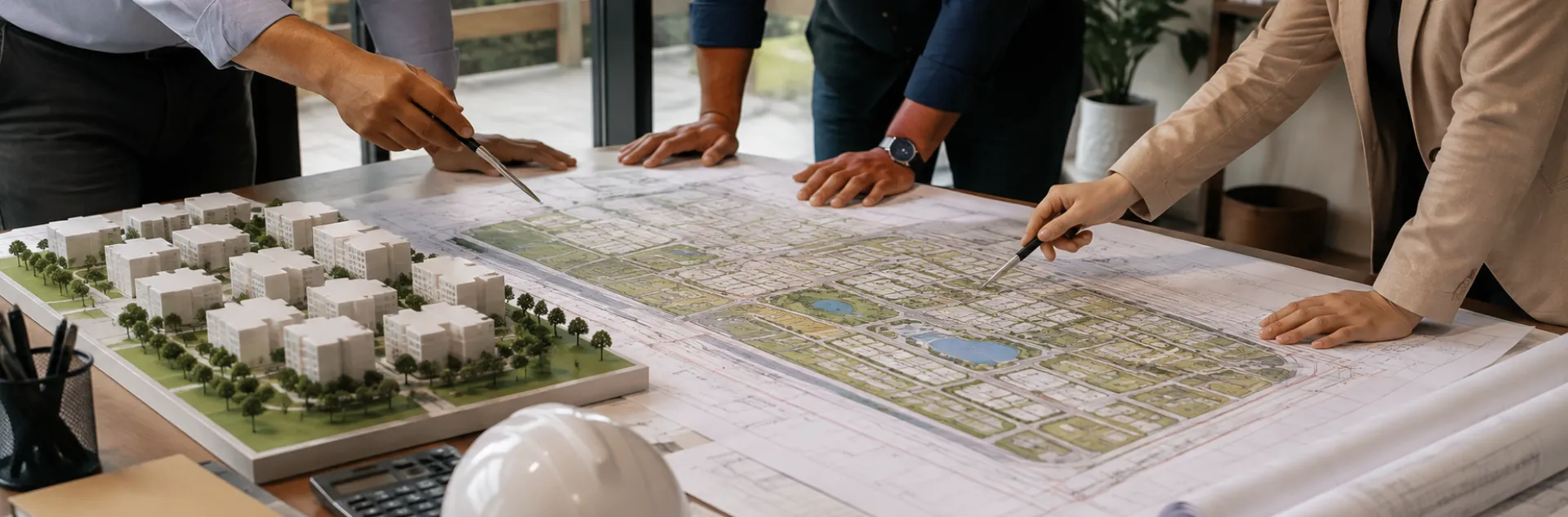
Ask any experienced developer where a project is truly won or lost, and most will point to the planning stage. Not the construction. Not the marketing. The decisions made when everything is still on paper.
Those decisions include more than structural and commercial considerations. They include how the site is oriented, how the built mass is distributed, and whether the spatial logic of the layout will work for or against the development over time.
Vastu Shastra for real estate has always operated at this level, and the same principles that shape Vastu Shastra for House layouts scale directly to large developments. Integrating it at the master planning stage is not about adding directional corrections after the layout is finalised. It is about bringing spatial intelligence into the earliest decisions, when everything is still flexible and the cost of getting it right is virtually zero.
Every spatial decision made at the master planning stage shapes the ones that follow Site orientation, tower placement, entry and exit points, zoning of functional areas, circulation corridors, and open space distribution are not isolated choices. Each decision has a compounding impact across the entire lifecycle of the development.
When Vastu principles inform these decisions from the beginning, the development is built on a foundation that supports both performance and experience. When they are applied later, the best a consultant can do is recommend corrections – entrance adjustments, cosmetic changes, and similar interventions, none of which address the underlying spatial logic of the layout.
The first master-planning decision that Vastu informs is the site orientation. Plot shape, natural slope, the influence of surrounding roads, and proximity to external disturbances such as high-tension lines or drainage channels are all fixed conditions. They cannot be changed after the fact. A site with a natural slope toward the north or east, roads on the northern or eastern sides, and a regular shape begins with a meaningful spatial advantage.
Identifying and evaluating these conditions before any planning begins is where Vastu thinking delivers its most consequential impact.
Once the site conditions are understood, how the built mass is distributed across the site becomes the next critical decision. In Vastu, taller and heavier structures belong in the south and southwest zones. The south and southwest carry the earth element, providing the stability required by large built masses. Keeping the north and northeast open preserves the flow of lighter, more energising energy across the development.
This directional massing logic also has a measurable impact on how natural light reaches lower structures, how air moves through the site, and how the development's overall microclimate is experienced by people living or working in it.
Beyond tower placement, the distribution of functional areas across a master plan determines how smoothly the development operates day to day. Entry and exit points in the north or northeast support active, welcoming energy. Recreational and open spaces in the northeast and east receive the best quality of morning light. Commercial and service zones in the southeast and south carry the fire - element energy that active, transactional spaces benefit from.
When these decisions are made with elemental logic, the master plan stops being a collection of zones and starts functioning as a coherent spatial system.
This is precisely the thinking behind the SVR™ framework developed by Sayash Vastu. The Sayash Vastu Rating evaluates real estate projects using a 100-point system that covers site selection, master planning, Panchtatva balance, energy flow, and future stability. It gives developers a structured, documented assessment of how well their master plan aligns with Vastu principles and provides a formal rating that carries genuine market credibility.
For developers who want spatial intelligence integrated from the ground up and a certification that communicates that quality to buyers and investors, SVR™ is where that process begins, backed by a team regarded among the best Vastu consultants in India for large-scale developments.
Sayash Vastu has worked with developers and architects across India for over three decades, bringing structured Vastu evaluation into master planning decisions from the earliest stages of development. To understand how SVR™ can strengthen your next project, visit sayashvastu.com or connect with Team Sayash Vastu directly.
At what stage of a project should Vastu be integrated?
At the master planning stage, before anything is finalised. Once the layout is locked, the window for meaningful spatial decisions has largely closed.
Does Vastu conflict with modern architectural planning?
It rarely does. Placing heavier mass in the south and southwest to manage afternoon heat is both a Vastu recommendation and a passive design principle. Most of the time, they are pointing in the same direction.
What master planning decisions does Vastu actually inform?
Site orientation, tower placement, entry positioning, functional zoning, open space distribution, and circulation. Each one has a spatial logic behind it, and each one affects the decisions that follow.
Can Vastu still help if construction has already started?
Some adjustments are possible, but the options narrow considerably once construction has begun. What takes minutes to change on paper can take months and significant money to address on site.
What is SVR™ and how does it connect to master planning?
SVR™ is Sayash Vastu’s 100-point rating framework for real estate projects. Master planning is one of the five categories it evaluates. A good master plan contributes directly to a stronger SVR™ rating.
How does Sayash Vastu work with developers at the planning stage?
The process starts with site evaluation. Conditions are assessed, directional alignment is established, and zoning recommendations feed into the master plan as it takes shape. It is a working process, not a review after the fact.